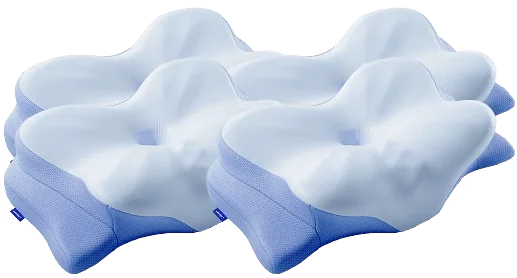
Why Stomach Sleepers Struggle With Contoured Pillows
Ergonomic contoured pillows are marketed broadly, but the underlying geometry that makes them work for side and back sleepers is often exactly what makes them uncomfortable for stomach sleepers.
Here's the mechanical reason behind the mismatch, and what to check before you buy.
The basic geometry problem
Contoured ergonomic pillows are generally built with a taller loft — often 4 to 6 inches or more — specifically to fill the gap between a sleeper's shoulder and the mattress when lying on their side, or to cradle the head's natural curve when on their back. That height is the whole point for those positions.
Stomach sleeping works differently. Lying face-down, there's no shoulder gap to fill, and the neck has to rotate to one side. A tall pillow under the head in this position pushes the neck upward and back, creating an arched, hyperextended angle rather than a neutral one.
Why this matters for spinal alignment
The general principle sleep-health guidance points to is keeping the spine roughly neutral — the nose aligned with the center of the chest, not tilted sharply up or down. A tall contoured pillow can push a stomach sleeper well outside that neutral range, potentially contributing to neck or lower-back strain rather than relieving it.
What this doesn't mean
It doesn't mean every stomach sleeper will have a bad experience with every contoured pillow, or that contoured pillows are poorly designed. It means the design intent specifically targets side and back sleeping, and stomach sleepers are working against the geometry rather than with it.
How this applies here
The Derila Ergo Pillow, at roughly 5.1 inches tall, follows exactly this pattern — well suited to side and back sleepers, and a poor match for dedicated stomach sleepers. See our full honest verdict and the fit guide for more detail.